- Built by
- Effigy Moundbuilders
- When
- c. 500–1000 CE
- Where
- near Baraboo, Sauk County
- Visiting
- Open to the public.
The only surviving human-shaped effigy mound in North America, about 214 feet long, striding with horns or a headdress. Its legs were cut off by a road; the rest is preserved in a county park.
The story
In the hills northeast of Baraboo, Wisconsin, a giant figure lies in the grass, striding with arms and legs outstretched and what look like horns or a headdress on its head. It is Man Mound, an earthen sculpture about 214 feet long and 48 feet wide, made roughly a thousand years ago. Of all the human-shaped effigy mounds once known in the Upper Midwest, it is the only one that survives.
Man Mound belongs to the great age of effigy mounds, when people across southern Wisconsin and neighboring states shaped the earth into the forms of birds, bears, panthers, water spirits and other beings, along with conical and long linear mounds. Wisconsin once held thousands of effigies, more than anywhere else. Many scholars connect them with a layered view of the world, with sky beings, earth beings and beings of the water and underworld, and the mounds often held burials. The Ho-Chunk Nation, whose homeland this is, honors these mounds as sacred places of its ancestors. Man Mound itself has never been excavated.
No one knows for certain who the figure represents. Some see a spirit being or a shape-shifter; the horns may show a figure transforming between human and animal, or a person in ceremonial dress.
Nearly lost
In July 1859 the surveyor and local historian William H. Canfield measured and mapped the mound and reported it to Increase Lapham, Wisconsin’s pioneering archaeologist, who published it that year. At that time the figure was complete. Over the following decades a road was cut straight through its lower legs, and the feet, across the road, were worn down in a cattle pasture. About 50 feet of the figure was lost.
When the rest was threatened with the plow, local historians stepped in to save it. The land was bought for $225, and Man Mound Park was dedicated in 1908. The mound was listed on the National Register of Historic Places in 1978. For the park’s centennial in 2008, the outline of the missing legs and feet was painted across the road and pasture using Canfield’s measurements, and in 2010 the protected boundary was expanded to include them. On October 31, 2016, Man Mound was designated a National Historic Landmark.
Visiting
Man Mound County Park is a small, free park about four miles northeast of Baraboo, off State Road 33 on Man Mound Road. A short path leads to the figure, with signs explaining its history.
- Do not walk on the mound. It is a sacred place and may be a grave.
- Be careful on the road, where the figure’s painted legs cross. Traffic does not expect pedestrians.
- Leave offerings and the grounds undisturbed.
Plan a respectful visit
Open to the public. Stay on paths, climb only where stairs are provided, and leave everything as you found it. Visiting guidelines
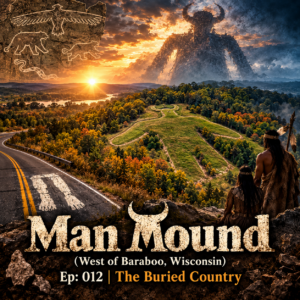 Watch the episodeMan Mound (Baraboo, Wisconsin) Ep: 012 | The Buried CountryWatch and read →
Also in Wisconsin
Sources
Spot a mistake, or know more about this place? Tell us.




