- Built by
- Powhatan (Virginia Algonquian)
- When
- c. 1200–1609 CE
- Where
- Purtan Bay, Gloucester County
- Visiting
- Not open to the public. Please respect the site and the people who care for it.
The capital of Wahunsenaca, the paramount chief known as Powhatan, on the York River, where John Smith was brought in 1607. The site is now protected by the National Park Service and is not yet open to visitors.
The story
On a quiet bay off the York River in Virginia, three creeks frame a low bluff above the water. In 1607 this was Werowocomoco, a name usually translated as “place of leadership.” It was the home of Wahunsenaca, the paramount chief the English called Powhatan, who ruled a network of more than thirty Algonquian-speaking nations across Tidewater Virginia.
It was here, in the winter of 1607 to 1608, that the captured John Smith was brought before Powhatan. Smith later wrote that the chief’s young daughter Pocahontas saved his life, a story he told years after the fact and that many historians, and many Virginia Indians, read very differently, perhaps as a ceremony adopting Smith into Powhatan’s world. Over the following months the English returned to Werowocomoco to trade and negotiate. The peace did not hold, and in 1609 Powhatan moved his capital farther inland, away from the newcomers.
A place of power long before Powhatan
For centuries the true location was lost. A chimney ruin on Timberneck Creek was long called Powhatan’s Chimney and thought to mark the spot. The real site came to light because Lynn Ripley, who lived on the bay with her husband Bob, kept finding Native artifacts on their land. Archaeologists surveyed the property in 2002, and in 2003 they announced that this was Werowocomoco. From 2003 to 2010 a team led by Martin Gallivan of the College of William & Mary, working with an advisory board of Virginia Indian leaders, excavated there.
What they found changed the story. People had lived on this bluff since about the 1200s. Around 1400, they dug a pair of long, curving ditches that set apart an inner area of the town, likely a sacred and political precinct. A Spanish copy of an English map from 1608, the Zúñiga map, seems to show those same ditches. Powhatan did not found Werowocomoco. He chose a place that was already old and already powerful. Copper ornaments, a prized material that Powhatan’s leaders controlled, turned up along with post holes from houses and pottery from centuries of daily life.
In 2016 the National Park Service bought the property, making it part of the Captain John Smith Chesapeake National Historic Trail. The Park Service is planning its future in consultation with the Virginia tribes whose ancestors lived here, including the Pamunkey and Mattaponi and other Powhatan descendant nations.
Visiting
Werowocomoco is not yet open to the public while the National Park Service and tribal partners plan how visitors will experience it. In the meantime, an exhibit about the site is on view at the Gloucester County Visitor Center, and nearby Machicomoco State Park, on the York River, is dedicated to Virginia’s Indigenous history.
- Please do not try to visit the property. Check the National Park Service page for news of public programs.
- Learn from the tribes themselves. Several Virginia nations host museums, powwows and public events.
- Remember that Pocahontas, Powhatan and their people are ancestors to living families, not legends.
Plan a respectful visit
Not open to the public. Please respect the site and the people who care for it. Stay on paths, climb only where stairs are provided, and leave everything as you found it. Visiting guidelines
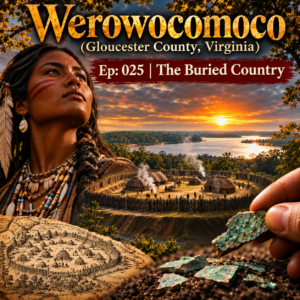 Watch the episodeWerowocomoco (Gloucester County, Virginia) Ep: 025 | The Buried CountryWatch and read →
Also in Virginia
Sources
Spot a mistake, or know more about this place? Tell us.




