- Built by
- Caddo
- When
- c. 800–1300 CE
- Where
- Alto, Cherokee County
- Visiting
- Open to the public.
The southwesternmost great mound center in North America: two platform mounds and a burial mound. A state historic site, still sacred to the Caddo Nation.
The story
In the Piney Woods of East Texas, on a bluff near the Neches River, three earthen mounds rise from a meadow. About 1,200 years ago, around 800 CE, ancestors of the Caddo people settled here and founded a town that became a great ceremonial center. It was the southwesternmost of all the major mound centers of ancient North America, the edge of a world of mound-building towns that reached from here to the Great Lakes.
The Caddo were farmers who lived in tall, round houses framed with poles and thatched with grass, often home to one or two families. Building one was a task for the whole town. At its height, the community near the mounds was a seat of religious and political leaders who drew people from scattered farmsteads across the surrounding forests for ceremonies, feasts and councils.
Each mound had its own purpose. Two were platform mounds, which held temples and important buildings on their flat tops. From time to time a temple was burned, covered with fresh earth, and a new one built on top, so the mounds grew higher over the centuries. The third mound was a burial place, where an estimated 90 people were laid to rest, many with offerings. By about 1300 the great ceremonial life of the site had ended, though Caddo people continued to live in the region.
The Caddo then and now
When Spanish and French explorers reached East Texas in the 1500s and 1600s, they found the Caddo confederacies powerful and well organized. The Spanish called one group the Tejas, a Caddo word for friend, and from it came the name Texas. The road the Spanish traveled, El Camino Real de los Tejas, passes close to the mounds. In the 1800s the Caddo were forced from their homeland. The Caddo Nation is headquartered today in Binger, Oklahoma, and maintains close ties to the site.
Storm and renewal
On April 13, 2019, during the site’s annual Caddo Culture Day, a tornado tore across the grounds. Dozens of people were hurt, and the visitor center and a traditional grass house were destroyed. The mounds themselves came through undamaged. After five years of work by the Texas Historical Commission and the Caddo Nation, the site reopened in May 2024 with a new visitor center and a rebuilt grass house.
Visiting
Caddo Mounds State Historic Site is about six miles southwest of Alto on Texas Highway 21. A trail leads past the mounds, a demonstration garden and the grass house, and the visitor center tells the story of the Caddo past and present. One of the temple mounds stands across the highway and is closed to visitors, though you can see it from a distance.
- Check hours, admission and the date of Caddo Culture Day with the Texas Historical Commission.
- Stay off the mounds. The burial mound is a grave of Caddo ancestors.
- Follow staff and Caddo guidance at ceremonies, and ask before taking photographs.
Plan a respectful visit
Open to the public. Stay on paths, climb only where stairs are provided, and leave everything as you found it. Visiting guidelines
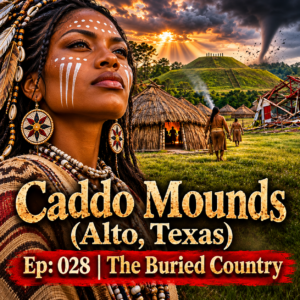 Watch the episodeCaddo Mounds (Alto, Texas) Ep: 028 | The Buried CountryWatch and read →
Also in Texas
Sources
Spot a mistake, or know more about this place? Tell us.




