- Built by
- Late Archaic
- When
- c. 2300–2000 BCE
- Where
- Edisto Island, Charleston County
- Visiting
- Open to the public.
Shell rings built by Late Archaic peoples more than 4,000 years ago, among the oldest known in North America. The Pockoy Island rings are being washed away by the rising sea and are not open to visitors; Spanish Mount, a shell mound on the edge of the marsh, can be seen from a trail in Edisto Beach State Park.
The story
On the edge of South Carolina’s Edisto Island, where salt marsh meets the Atlantic, people of the Late Archaic period gathered more than 4,000 years ago and built monuments out of shell. Over generations they piled oyster, clam and other shells, along with animal bone, pottery and tools, into great rings and mounds. These are among the oldest such structures on the continent, older than the first farming villages of the Southeast.
Shell rings are found along the coasts of South Carolina, Georgia and Florida, and all date to the Late Archaic, roughly 5,000 to 3,000 years ago. Some are full circles, others are C- or U-shaped, and each surrounds an open central space. Archaeologists still debate their purpose. Many see them as places where communities came together to feast, celebrate and share the abundance of the marsh, building the ring higher with every gathering.
Pockoy Island
The Pockoy Island rings were found by accident. In early 2017, analysts studying how Hurricane Matthew had reshaped the coast noticed two circular features on aerial laser scans, called LiDAR. Shovel tests that summer confirmed a shell ring, and radiocarbon dates on animal bone showed it was about 4,300 years old, the oldest known shell ring in South Carolina. A second ring lies nearby. The evidence suggests the first ring was built over a relatively short span.
The discovery came with a clock running. Pockoy Island, part of the state’s Botany Bay Plantation Heritage Preserve, is being swallowed by the rising sea, and the ring is washing away. State archaeologists carried out large public excavations in 2018 and 2019 to recover what they could, and the oyster shells they measured are now helping scientists understand the health of ancient oyster reefs and how this coastline has changed.
Spanish Mount
A short distance away, at the edge of the marsh in Edisto Beach State Park, stands Spanish Mount, a shell mound about 4,000 years old. Accounts from the early 1800s describe a much larger mound; the tides and the creek have since carried most of it away. A retaining wall built in the mid-2000s was badly damaged in the historic floods of 2015, and archaeologists made a final recovery at the mound in 2017. The state’s archaeologists have said plainly that this ancient site will likely disappear within our lifetime. Spanish Mount is notable too for its unusually large oyster shells.
Visiting
The Pockoy Island rings are not open to visitors. Spanish Mount can be seen at the western end of the 1.7-mile Spanish Mount Trail in Edisto Beach State Park, a flat walk through maritime forest and along the marsh. Botany Bay Plantation Heritage Preserve, run by the South Carolina Department of Natural Resources, is open to visitors and known for its beach of fallen trees.
- View Spanish Mount from the trail. Do not climb on the shell or remove anything.
- At Botany Bay, nothing may be removed, including shells, artifacts and driftwood.
- Check park hours and trail conditions before you go; storms sometimes close trails.
Plan a respectful visit
Open to the public. Stay on paths, climb only where stairs are provided, and leave everything as you found it. Visiting guidelines
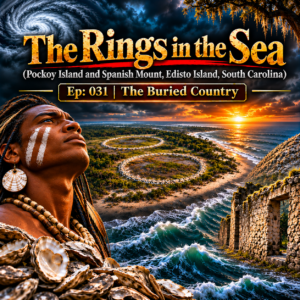 Watch the episodeThe Rings in the Sea (Pockoy Island and Spanish Mount, Edisto Island, South Carolina) Ep: 031 | The Buried CountryWatch and read →
Also in South Carolina
Sources
Spot a mistake, or know more about this place? Tell us.




