- Built by
- Caddoan Mississippian
- When
- c. 800–1450 CE
- Where
- Spiro, Le Flore County
- Visiting
- Open to the public.
The great burial mound at Spiro. Its hollow inner chamber preserved wood, shell and textiles until commercial diggers tore into it in the 1930s. Now restored to its original shape.
The story
On the Arkansas River in eastern Oklahoma, just west of Fort Smith, lies Spiro, one of the four great regional centers of the Mississippian world alongside Cahokia, Moundville and Etowah. Spiro’s leaders had ties to peoples from the Rocky Mountains to the Virginia coast and from the Gulf of Mexico to the Great Lakes. Of its twelve mounds, nine held houses, two held temples, and one was for the dead. That one is Craig Mound. (For the story of the whole site, see the Spiro Mounds page.)
Craig Mound, the second-largest mound at Spiro, stands about a quarter mile southeast of the main plaza. It was raised in stages over a series of ground-level mortuary buildings, some of which may be older than the mound itself, and it grew to a long ridge of joined cones, the main one about 33 feet high. Even after most people moved away from Spiro, its role as a ceremonial and burial center continued and even grew, until about 1450.
The Great Mortuary
Deep inside the mound was something found nowhere else: a hollow chamber that archaeologists came to call the Great Mortuary. It began as a burial place for Spiro’s highest leaders, who were laid to rest on litters of cedar poles. Because the chamber stayed sealed and dry, it preserved things that almost never survive in the ground: woven textiles and lace-like fabrics, baskets, feathers and fur, along with engraved shell cups, copper plates showing warriors, and carved stone pipes. It was the richest collection of grave goods ever reported in the continental United States, and some scholars believe much of it was placed there in a single great ceremony.
Plundered
After about 1600 no one lived at Spiro, until Choctaw and Chickasaw freedmen cleared the land for farming in the 1870s. In 1933, during the Great Depression, a group of treasure diggers calling themselves the Pocola Mining Company leased the right to dig in Craig Mound. They tunneled straight into it, broke open the hollow chamber, and pulled out its contents to sell. Fragile cloth and feathers crumbled as they were exposed to air; shell and copper were broken up and sold by the piece. Newspapers compared the find to King Tut’s tomb. The continuing destruction led the Oklahoma Legislature to require a license to dig at the site, and in November 1935 the miners were finally shut down, but the damage was done. Objects from Craig Mound are still scattered among museums and private collections around the world.
In 1936 the University of Oklahoma and the Works Progress Administration began careful excavations of what remained. Craig Mound was later rebuilt to its approximate original shape.
Visiting
Craig Mound is part of Spiro Mounds Archaeological Center, run by the Oklahoma Historical Society, near the town of Spiro. Trails lead from the interpretive center past the mounds, and exhibits display objects from the site, including some of the rare perishable materials.
- Check hours with the Oklahoma Historical Society before you go.
- Stay off the mounds, above all Craig Mound. It is a grave of Caddo and Wichita ancestors.
- Never buy artifacts said to come from Spiro. Much of that trade began with the looting.
Plan a respectful visit
Open to the public. Stay on paths, climb only where stairs are provided, and leave everything as you found it. Visiting guidelines
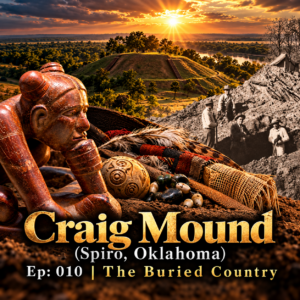 Watch the episodeCraig Mound (Spiro, Oklahoma) Ep: 010 | The Buried CountryWatch and read →
Also in Oklahoma
Sources
Spot a mistake, or know more about this place? Tell us.




