- Built by
- Adena or Fort Ancient (debated)
- When
- c. 300 BCE or c. 1070 CE
- Where
- Peebles, Adams County
- Visiting
- Open to the public.
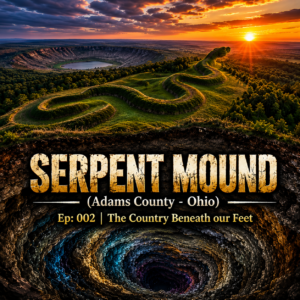
The world's largest serpent effigy, about 1,350 feet long, uncoiling along a bluff over Brush Creek on the rim of an ancient impact crater. Its head aligns with the summer-solstice sunset.
The story
On a high plateau above Ohio Brush Creek, a great serpent of earth uncoils across the land. Serpent Mound is about 1,348 feet long from the tip of its tightly coiled tail to its open jaws, the largest serpent effigy in the world. The body rises only about three feet high and a little over 20 feet wide, winding in seven curves along the ridge. At its head, the serpent’s jaws open around an oval of earth that people have read as an egg, an eye, or the sun.
Serpent Mound holds no burials and almost no artifacts. It was made to be seen, walked and remembered. Many researchers have noted that the head points toward the sunset on the summer solstice, and some see other alignments with the sun and moon in its curves. Whatever its full meaning, it is one of the most powerful sacred images ever shaped from earth.
Who built it?
For more than a century, archaeologists have argued over who made the serpent. Early researchers credited the Adena people, who built burial mounds nearby more than 2,000 years ago. In the 1990s, radiocarbon dates from charcoal inside the mound pointed instead to the Fort Ancient people, around 1070 CE, a culture known for serpent imagery. In 2014, a new study of soil cores argued that the Adena built it around 300 BCE and that Fort Ancient people repaired or renewed it many centuries later.
The question is still open, and perhaps both answers hold part of the truth: a sacred place made by one people and honored, rebuilt and kept by those who came after.
A strange place on the earth
The serpent lies on top of one of the most unusual geological features in the Midwest, the Serpent Mound crater, a disturbed zone of bedrock about eight miles across. Geologists believe it was formed hundreds of millions of years ago, most likely by a meteorite impact. Whether the builders sensed something special about this ground, they chose a place where the rocks themselves are twisted and broken.
Saving the serpent
By the 1880s, the serpent was threatened by plowing. Frederic Ward Putnam of Harvard’s Peabody Museum studied the site in the late 1880s and raised money to buy it and restore it as one of the first archaeological preserves in the United States. Ownership later passed to the people of Ohio, and the Ohio History Connection still manages the site. Serpent Mound is a National Historic Landmark and has been under consideration as a UNESCO World Heritage Site.
Visiting
Serpent Mound is near Peebles in Adams County, Ohio, about 73 miles east of Cincinnati. A paved path circles the serpent, and a small museum explains its history and the geology beneath it. An observation tower lets you take in the coils from above.
- Stay on the path. The serpent is low and easily worn away by footsteps.
- Check hours and events with the site before you go, especially around the solstices, when the site draws visitors.
- Many Native people consider this a sacred place. Visit quietly and leave everything as you found it.
Plan a respectful visit
Open to the public. Stay on paths, climb only where stairs are provided, and leave everything as you found it. Visiting guidelines
 Watch the episodeSerpent Mound (Adams County – Ohio) Ep: 002Watch and read →
Also in Ohio
Sources
Spot a mistake, or know more about this place? Tell us.




