- Built by
- Ancestral Puebloan
- When
- c. 850–1150 CE
- Where
- Chaco Culture National Historical Park, San Juan County
- Visiting
- Open to the public.
Two large earthen platform mounds, faced with masonry, stand in front of Pueblo Bonito, the greatest of the Chacoan great houses. Their purpose is still debated.
The story
In Chaco Canyon, in the high desert of northwestern New Mexico, stands Pueblo Bonito, the greatest of the Chacoan great houses. Built in stages from the mid-800s into the 1100s, it rose four or more stories in a vast D shape, with hundreds of rooms and dozens of round ceremonial chambers called kivas. For more than two centuries Chaco was the center of a world that reached across the Four Corners, linked by long, straight roads and by trade that brought turquoise, shell and even macaws and cacao from Mexico.
In front of Pueblo Bonito, on its south side facing the canyon, lie two large mounds of earth, the East Mound and the West Mound. They were noticed by the first explorers to map the site in the 1800s and dug into by archaeologists between 1896 and 1927, but they have always been harder to explain than the great house behind them.
Trash, monument, or both?
The mounds hold enormous amounts of construction debris and household refuse, built up during the fast growth of Pueblo Bonito between about 1040 and 1100 CE. For decades scholars have argued over what that means. Some see the mounds as trash heaps that grew as the great house did. Others see deliberately shaped platform mounds, monuments that showed the power of leaders able to command labor, like platform mounds in other parts of North America.
Recent fieldwork by the University of New Mexico, published in 2021, traced how each mound was built, layer by layer. The researchers concluded that the mounds were neither simple dumps nor proof of rule by a powerful few. Instead, they argue, the mounds grew out of the changing landscape in front of the great house and the complex social negotiations of a time of rapid change. Other archaeologists see the mounds of Chaco’s great houses as sacred places of deposit, where earth and refuse from ceremonies and building were laid down with meaning, a practice traced from early Pueblo times to today.
Chaco’s descendants
Chaco is not a vanished world to the Pueblo peoples of New Mexico and Arizona, including the Hopi and Zuni, who count it among their ancestral places. The Navajo, whose homeland surrounds the canyon, have their own long history with it. Chaco Culture National Historical Park is a UNESCO World Heritage Site.
Visiting
Chaco Culture National Historical Park is remote, reached by miles of rough dirt road; check road conditions before you go. A loop road leads to Pueblo Bonito, where a trail winds through the great house and past the mounds in front of it. There are no services in the canyon beyond the visitor center and a campground.
- Stay on marked trails, and do not sit, stand or climb on walls or mounds.
- Leave every sherd and stone where it lies. Collecting is a federal crime.
- Bring water, fuel and food. Summer heat and winter cold can both be severe.
Plan a respectful visit
Open to the public. Stay on paths, climb only where stairs are provided, and leave everything as you found it. Visiting guidelines
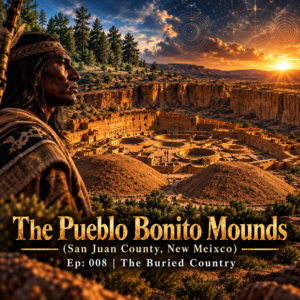 Watch the episodeThe Pueblo Bonito Mounds (San Juan County, New Mexico) Ep: 008 | The Buried CountryWatch and read →
Sources
Spot a mistake, or know more about this place? Tell us.




