- Built by
- Plaquemine and Natchez
- When
- c. 1200–1730 CE
- Where
- Natchez, Adams County
- Visiting
- Open to the public.
The main ceremonial center of the Natchez Nation until 1730, with three surviving mounds, a museum and a reconstructed house.
The story
On the banks of St. Catherine Creek in Natchez, Mississippi, three earthen mounds stand in a quiet park. In the early 1700s this was the Grand Village, the ceremonial capital of the Natchez Nation and home of its paramount chief, the Great Sun. It is one of the few places in North America where mound-building ceremonies were described by European eyewitnesses while they were still being carried out.
The site is much older than the French records. People were living here by about 1200 CE, and the mounds were built in stages, probably beginning in the 1200s, by people of the Plaquemine culture, ancestors of the Natchez. For generations the main ceremonial center of the region was Emerald Mound, about ten miles to the northeast and the second-largest ceremonial mound in the United States. Sometime before the French arrived in the late 1600s, that role shifted to the Grand Village.
The Great Sun and the temple
French explorers, priests and colonists who came to Natchez between 1682 and 1729 wrote detailed accounts of the town. The Great Sun lived in a large house on top of the central mound, Mound B, now called the Great Sun’s Mound. On Mound C, the southern mound, stood a temple where a sacred fire was kept and where the remains of the elite were cared for. Between the mounds lay an open plaza where the nation gathered for ceremonies, feasts and games. A third mound, Mound A, now called the Abandoned Mound, seems to have been out of use by French times.
The French also recorded the funeral of the Great Sun’s brother, the war chief known as Tattooed Serpent, in 1725, an elaborate ceremony in which some of his relatives and attendants gave their lives to accompany him. Archaeologists who excavated the site in the 1960s found burials that may belong to Tattooed Serpent and to the Great Sun, who died in 1728.
War and scattering
As French settlers took more Natchez land, relations broke down. After the Great Sun’s death, his successor was more hostile to the French, and in November 1729 the Natchez attacked nearby Fort Rosalie and the surrounding settlements. The French and their Choctaw and Tunica allies struck back, and in 1730 the Natchez were defeated and the Grand Village abandoned. Many Natchez were killed or enslaved and sent to the Caribbean. Survivors found refuge among the Chickasaw, Creek and Cherokee, and Natchez descendants live today within those nations in Oklahoma and the Southeast.
Visiting
The Grand Village of the Natchez Indians is a 128-acre park and National Historic Landmark run by the Mississippi Department of Archives and History, which has renamed it the Natchez Tribal History Center as it plans a new museum. The Great Sun’s Mound and the Temple Mound were excavated and rebuilt to their original size and shape. The grounds include a museum, a reconstructed Natchez house and a nature trail. Emerald Mound, on the Natchez Trace Parkway, makes a natural second stop.
- Check museum hours with MDAH before you go.
- Stay off the mounds. The Temple Mound held the graves of Natchez leaders.
- Remember that the Natchez story is not over. Their descendants still carry it.
Plan a respectful visit
Open to the public. Stay on paths, climb only where stairs are provided, and leave everything as you found it. Visiting guidelines
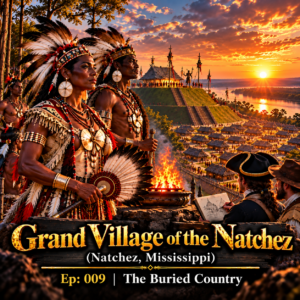 Watch the episodeGrand Village of the Natchez (Natchez, Mississippi) Ep: 009 | The Buried CountryWatch and read →
Also in Mississippi
Sources
Spot a mistake, or know more about this place? Tell us.




