- Built by
- Archaic and Woodland copper miners
- When
- c. 2500 BCE–1000 CE
- Where
- Isle Royale, Keweenaw County
- Visiting
- Open to the public.
Thousands of ancient pits where Native miners pounded pure copper from the bedrock of Isle Royale with stone hammers, over thousands of years. Part of Isle Royale National Park, reached by boat or seaplane.
The story
Isle Royale, a wild island in the far north of Lake Superior, holds some of the oldest mines in North America. Along Minong Ridge, on the island’s north side, the bedrock is threaded with veins of pure native copper, metal so clean it can be shaped without smelting. Beginning about 4,500 years ago, Native miners came here by canoe across open water to get it.
Their method was patient and powerful. Miners heated the rock with fire, may have cooled it with water to crack it, and then pounded it apart with heavy, rounded beach cobbles used as hammerstones. They dug pit after pit following the copper veins. When nineteenth century prospectors arrived, they found the old diggings running in an almost unbroken line for more than two miles, the pits so close together there was barely room to walk between them. Piles of broken hammerstones still lie near the pits. A charred log from one pit has been radiocarbon dated to around 1500 BCE, and mining here went on for thousands of years.
The copper was cold-hammered into awls, knives, spear points, fishhooks, beads and ornaments. Lake Superior copper was traded far beyond the Great Lakes and turns up at ancient sites across much of eastern North America. Minong, the Ojibwe name for Isle Royale, was one of its great sources.
The miners who followed
Modern miners used the ancient pits as guides. In 1874 the Minong Mining Company was organized in Detroit, and from about 1875 to 1885 it worked the ridge, sinking shafts, blasting quarries and building a small settlement. Like every commercial copper venture on Isle Royale, it never turned a lasting profit. Today the district combines one of the largest and best preserved ancient copper mining landscapes in the Lake Superior region with the remains of the largest historic mine on the island. It was listed on the National Register of Historic Places in 1977 and designated a National Historic Landmark in 2021.
The Grand Portage Band of Lake Superior Chippewa maintains a lasting relationship with the island, recognized by the National Park Service as the Minong Traditional Cultural Property.
Visiting
The Minong Mine is inside Isle Royale National Park, one of the least visited and most remote parks in the country. The island is reached only by ferry or seaplane, generally from late spring to early fall, and the mine area is a hike from McCargoe Cove. Plan carefully, and carry everything you need.
- Check the park’s season, ferry schedules and backcountry rules before you go.
- Hammerstones, copper and all other artifacts are protected by federal law. Leave every stone where it lies.
- Old pits, shafts and quarries are dangerous. Stay on trails and keep out of mine openings.
Plan a respectful visit
Open to the public. Stay on paths, climb only where stairs are provided, and leave everything as you found it. Visiting guidelines
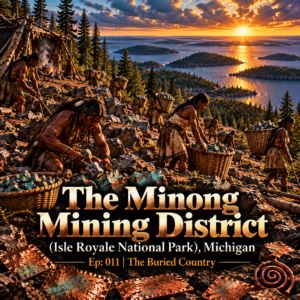 Watch the episodeThe Minong Mining District (Isle Royale, Michigan) Ep: 011 | The Buried CountryWatch and read →
Also in Michigan
Sources
- National Park Service: Archaeological history of Isle Royale and ancient copper mining
- National Park Service: Minong Mine designated a National Historic Landmark
- National Parks Traveler: Isle Royale’s Minong Mine designated National Historic Landmark
- U.S. Geological Survey: The geologic story of Isle Royale National Park
- Wikipedia: Minong Mine Historic District
Spot a mistake, or know more about this place? Tell us.




