- Built by
- Tequesta
- When
- about 2,000 years ago
- Where
- Brickell Point, Miami
- Visiting
- Open to the public.
A ring of 24 basins cut into the limestone bedrock at the mouth of the Miami River, made by the Tequesta about 2,000 years ago and found in 1998 during construction. Saved from development, it was reburied for protection beneath a public park.
The story
Where the Miami River empties into Biscayne Bay, surrounded today by glass towers, lies a perfect circle cut into the bedrock about 2,000 years ago. Its makers were the Tequesta, the people who lived along Florida’s southeastern coast for centuries before Europeans arrived. They carved 24 large basins, some nearly two feet deep, into the soft limestone in a ring 38 feet across, along with hundreds of smaller holes around it.
No one knows for certain what the circle was. Many archaeologists think the basins held posts for a large wooden building, perhaps a council house or a ceremonial structure, rebuilt over time. Others have pointed out alignments that may relate to the sky. What is clear is that this point of land mattered. Dark soil full of shell, animal bone, stone axes and shell tools shows people lived and worked here over a long span, and human burials were found nearby. Dating places the site somewhere between about 1,700 and 2,700 years old.
When the Spanish reached Florida, the Tequesta’s main village, also called Tequesta, stood on the north bank of the river. The settlement at Brickell Point was an older part of that same long story.
The fight to save it
In 1998 an apartment complex on the point was torn down to make way for luxury condominiums. Before construction, county archaeologist Robert Carr led a salvage dig. When his team reached the limestone, they found holes in a curving line. Carr worked out the center of the curve, projected where the rest should be, and found them. In January 1999 the discovery of the Miami Circle was announced.
News of the circle set off a public campaign. Native people, preservationists, scholars and ordinary Miamians rallied to stop the bulldozers, and the State of Florida bought the land. Wild claims followed too, including that it was the work of the Maya or Olmec, but the evidence points to the Tequesta. The site was listed on the National Register of Historic Places in 2002. To protect it from weather and wear, the circle was carefully reburied in 2003, and on January 16, 2009 it was declared a National Historic Landmark.
Visiting
Miami Circle Park is a free public park on the south bank of the river at Brickell Point, open daily with interpretive signs. The circle itself lies safely beneath the ground, so what you see is the place rather than the carved stone. Objects recovered from the site are cared for by HistoryMiami Museum.
- Walk on the paths and lawn only, and do not dig or disturb the ground.
- People were buried at this site. Visit it as you would a cemetery.
- For the story behind the circle, pair your visit with HistoryMiami’s exhibits on Florida’s first peoples.
Plan a respectful visit
Open to the public. Stay on paths, climb only where stairs are provided, and leave everything as you found it. Visiting guidelines
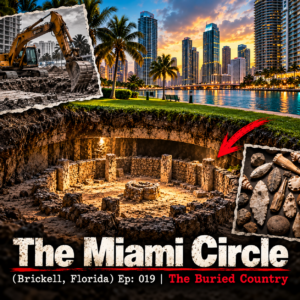 Watch the episodeThe Miami Circle (Brickell, Florida) Ep: 019 | The Buried CountryWatch and read →
Also in Florida
Sources
Spot a mistake, or know more about this place? Tell us.




