- Built by
- Adena
- When
- c. 250–150 BCE
- Where
- Moundsville, Marshall County
- Visiting
- Open to the public.
The largest conical burial mound in the United States, about 62 feet high and 240 feet across. Tunneled into in 1838, now protected beside the Delf Norona Museum.
The story
In the middle of Moundsville, West Virginia, a town named for it, rises the largest conical burial mound in the United States. Grave Creek Mound stands about 62 feet high and some 240 feet across, and when it was first measured in the 1800s it was even taller. It was built by the people archaeologists call the Adena, between about 250 and 150 BCE, in stages over a century or more. Raising it took the movement of more than 57,000 tons of earth, all by hand.
The Adena lived in the Ohio Valley during the Early Woodland period. They hunted, fished, gathered and grew a few native plants, lived in small communities, and honored their dead with earthen mounds, often adding new burials and new layers over generations. Grave Creek was the greatest of them all, a monument raised over important people. Many smaller mounds once stood nearby on the flats above the Ohio River.
The dig of 1838
European settlers came upon the mound around 1770, when the Tomlinson family built a cabin on Grave Creek Flats, and a traveler named Nicholas Cresswell described it in detail in 1775. In March 1838, Abelard Tomlinson, whose family owned the land, and his brother-in-law Thomas Biggs began digging into it, hoping it would be a profitable attraction. They drove two horizontal tunnels and a vertical shaft into the heart of the mound and found two burial vaults, one above the other, with human remains, shell beads and other objects. The digging, carried out with no scientific care, destroyed much of what the mound could have told us.
The dig also produced the Grave Creek Stone, a small sandstone disk carved with about two dozen strange characters. It set off a long argument over whether it was ancient writing from overseas. Most scholars today consider it a hoax, and the original has been lost.
After the dig, the tunnels were lined with brick and the mound became a tourist attraction. Later, the state penitentiary was built right beside it, and for years the mound was looked after by the prison warden. Through the efforts of the amateur archaeologist Delf Norona and the West Virginia Archeological Society, a mound museum opened in 1952. The mound was made a National Historic Landmark in 1964 and a state park in 1967.
Visiting
Today the mound is the centerpiece of the Grave Creek Mound Archaeological Complex in Moundsville, about 15 minutes south of Wheeling. The Delf Norona Museum beside it tells the story of the Adena and of West Virginia archaeology, and displays a replica of the Grave Creek Stone.
- Check hours with the West Virginia Department of Arts, Culture and History before you go.
- If a path to the summit is open, stay on it. Do not climb the slopes.
- Remember that this is a burial mound, raised over the dead more than 2,000 years ago.
Plan a respectful visit
Open to the public. Stay on paths, climb only where stairs are provided, and leave everything as you found it. Visiting guidelines
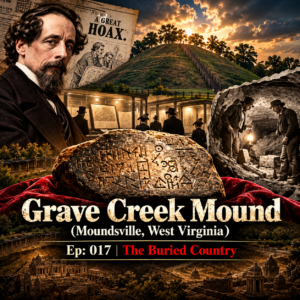 Watch the episodeGrave Creek Mound (Moundsville, West Virginia) Ep: 017 | The Buried CountryWatch and read →
Also in West Virginia
Sources
Spot a mistake, or know more about this place? Tell us.




