- Built by
- Mandan
- When
- c. 1490–1785 CE
- Where
- north of Bismarck, Burleigh County
- Visiting
- Open to the public.
A great Mandan town above the Missouri River, ringed by fortification ditches, with large refuse mounds and the depressions of earthlodges still visible. A state historic site.
The story
On a high terrace above the Missouri River, north of Bismarck, the ground is ringed by long, curving trenches and dotted with round hollows and grassy hills. For nearly 300 years, from about 1490 to 1785, this was a busy Mandan town. The round hollows are the remains of earthlodges, the big domed houses of timber and earth that sheltered Mandan families. The hills are middens, heaps of everyday refuse that grew for generations. The trenches are what is left of the town’s defenses.
Double Ditch was one of seven to nine Mandan towns that stood near the mouth of the Heart River at the same time, home together to perhaps 10,000 people or more. The Mandan were skilled farmers who raised corn, beans, squash and sunflowers in gardens on the river bottoms, and their towns were among the great trading centers of the northern Plains. People came from far away to exchange bison hides and meat for Mandan corn, and goods passed through here from the Rocky Mountains to the Great Lakes.
Four ditches, not two
The name comes from the two fortification ditches easy to see on the surface, but modern geophysical surveys have revealed four. Each marks a different stage in the town’s life. The outermost and oldest ditch enclosed the founding community, which was at its largest in the town’s first decades. Over time the town drew inward and new, smaller defensive lines were dug, with wooden palisades standing alongside them. Lodges were rebuilt again and again on the same spots.
The end of a town
About 1781 and 1782, a smallpox epidemic swept across the interior of North America. It devastated the Mandan, and Double Ditch and the other towns near the Heart River were abandoned. Survivors moved north up the Missouri. Their descendants are part of the Mandan, Hidatsa and Arikara Nation, the Three Affiliated Tribes, on the Fort Berthold Reservation near New Town.
Today the State Historical Society of North Dakota cares for the site, which is listed on the National Register of Historic Places. A building and walls put up here during the Great Depression as work-relief projects are historic in their own right.
Visiting
Double Ditch Indian Village State Historic Site is about seven and a half miles north of Bismarck on Highway 1804 and is open year-round. A paved path circles the town, with signs explaining the lodges, middens and ditches, and the river views are wide open.
- Stay on the path. The lodge floors, middens and ditches are fragile, and the ground holds the remains of homes.
- Leave everything as you find it. Collecting artifacts on state historic sites is illegal.
- Pair your visit with On-A-Slant Village at Fort Abraham Lincoln State Park and the North Dakota Heritage Center in Bismarck.
Plan a respectful visit
Open to the public. Stay on paths, climb only where stairs are provided, and leave everything as you found it. Visiting guidelines
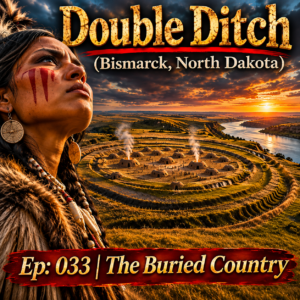 Watch the episodeDouble Ditch (Bismarck, North Dakota) Ep: 033 | The Buried CountryWatch and read →
Sources
Spot a mistake, or know more about this place? Tell us.




