- Built by
- Hopewell and Dakota
- When
- c. 1–1700 CE
- Where
- St. Paul, Ramsey County
- Visiting
- Open to the public.
Six surviving burial mounds of an original group of up to 37 on the bluff above the Mississippi, sacred to the Dakota.
The story
High on a bluff above the Mississippi River, looking west over downtown St. Paul, six earthen burial mounds rise from the grass. They are the survivors of a much larger cemetery. In the 1800s surveyors counted dozens of mounds on this bluff and on the slope below it, the largest group in what is now the Twin Cities. These six include some of the tallest mounds ever built in Minnesota.
The earliest mounds here are about 1,500 to 2,000 years old, raised during the Middle Woodland era, when people across the Midwest honored their dead with earthen monuments. Much later the Dakota buried their own dead on the bluff, and the place stayed in use as a cemetery into the 1800s, when the Dakota village of Kaposia stood nearby on the river. The City of St. Paul now describes the site plainly: it is a cemetery, built by the ancestors of living people.
In 2025, in a Dakota-led effort, the city renamed the park Wicaḣapi, a Dakota word meaning burial place. The nature sanctuary below it, formerly Bruce Vento Nature Sanctuary, became Waḳaƞ Ṭípi, and together the two are recognized as one sacred landscape, Imniżaska, “white cliffs.”
The Dwelling Place of the Sacred
Below the mounds, in the sandstone bluff, is a cave the Dakota call Waḳaƞ Ṭípi, often translated as Dwelling Place of the Sacred. Its walls once held carvings and paintings. In 1766 the English traveler Jonathan Carver stopped here and described many figures cut into the soft stone, and the cave has been known as Carver’s Cave ever since. The land around the cave later spent a century as a rail yard and industrial ground, and the carvings Carver saw are no longer visible. Dakota leaders today say the mounds and the cave belong together as one place, and a Native-led nonprofit, Wakan Tipi Awanyankapi, now helps care for the sanctuary.
What was lost and what was saved
As St. Paul grew, most of the mounds were plowed, dug into or leveled. In 1890 the city began buying land on Dayton’s Bluff for a park, following a proposal by the landscape architect H.W.S. Cleveland. The park was established in 1892 and was so popular that a streetcar line was built out to it in 1894. But park construction itself destroyed many of the remaining mounds. Only six were kept. The site was added to the National Register of Historic Places in 2014.
Visiting
Wicaḣapi is a public park east of downtown St. Paul, with paths along the bluff and some of the best river views in the city. Waḳaƞ Ṭípi lies below, with walking trails and the site of the Wakan Tipi Center, a Dakota-led cultural center scheduled to open in 2026; check its hours before you go. The cave entrance is gated and closed, but can be seen from across a pond.
- The mounds are graves. Do not climb, sit or play on them, and keep pets off.
- Read the signs the city and Dakota partners have placed, which tell the story in their words.
- Do not try to enter the cave. Respect any offerings you see.
Plan a respectful visit
Open to the public. Stay on paths, climb only where stairs are provided, and leave everything as you found it. Visiting guidelines
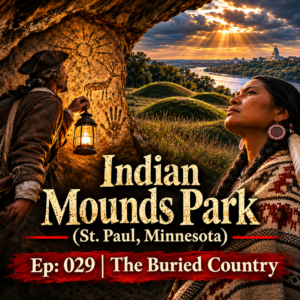 Watch the episodeIndian Mounds Park (St. Paul, Minnesota) Ep: 029 | The Buried CountryWatch and read →
Also in Minnesota
Sources
Spot a mistake, or know more about this place? Tell us.




