- Built by
- Mississippian
- When
- c. 1000–1550 CE
- Where
- Cartersville, Bartow County
- Visiting
- Open to the public.
Six mounds and a plaza on the Etowah River. Mound A rises about 63 feet, and the site yielded famous marble statues and copper plates.
The story
Where Pumpkinvine Creek meets the Etowah River in northwest Georgia, a great Mississippian town stood for more than five centuries. Its builders were the ancestors of the Muscogee (Creek) people, and its name comes from their word italwa, “town.” Between about 1000 and 1550 CE, chiefs who ruled from Etowah held power across the Etowah Valley and beyond.
The 54-acre site holds at least six mounds around a plaza. The greatest, Mound A, rises about 63 feet and covers about two and a half acres at its base, one of the largest mounds in North America. Its broad summit once held the temple and house of the town’s highest leaders. Mound B stands beside it, and Mound C, smaller but no less important, served as a burial mound for the town’s elite. The whole town was ringed by a deep defensive ditch.
Etowah’s story was not one long rise. The town was settled around 1000 CE, emptied for a time, and reoccupied around 1250, beginning more than a century of its greatest power and artistry. By the 1500s it was much reduced. When Hernando de Soto’s expedition marched through the region in 1540, it may have passed a town called Itaba, which some historians identify with Etowah.
What was found here
Mound C, built in seven stages between about 1250 and 1375, held some of the finest objects ever found in the Southeast: copper plates embossed with winged dancers, carved shell gorgets, painted pottery and ceremonial stone axes. The most famous treasures are a pair of marble statues of a kneeling woman and a seated man, carved more than 700 years ago and among the masterpieces of ancient American art. They are displayed side by side in the site’s museum. Mound C was excavated between the 1880s and 1960s; the mound you see today is a reconstruction.
In 2022, many funerary objects from Etowah were returned to the Muscogee (Creek) Nation. The Muscogee (Creek) Nation of Oklahoma and the Poarch Band of Creek Indians of Alabama consider Etowah their most important ancestral town, and the Cherokee, who later lived in this valley, also hold it sacred.
Visiting
Etowah Indian Mounds State Historic Site is about three miles south of Cartersville, Georgia. A museum holds the marble statues and other objects from the site, and a walking trail leads around the mounds and along the river. Modern steps climb to the summit of Mound A, where you can look out over the plaza and the river valley the town’s leaders once ruled.
- Check hours and events with Georgia State Parks before you visit.
- Climb only by the steps, and stay off the other mounds.
- Mound C was a burial place. Visit it as you would a cemetery.
Plan a respectful visit
Open to the public. Stay on paths, climb only where stairs are provided, and leave everything as you found it. Visiting guidelines
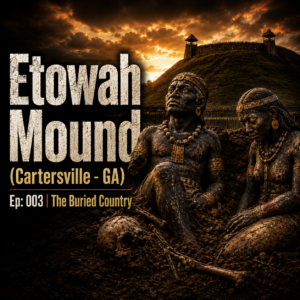 Watch the episodeEtowah Mound (Cartersville – GA) Ep: 003 | The Buried CountryWatch and read →
Also in Georgia
Sources
Spot a mistake, or know more about this place? Tell us.




