- Built by
- Plum Bayou culture
- When
- c. 650–1050 CE
- Where
- Scott, Lonoke County
- Visiting
- Open to the public.
Once 18 mounds inside an earthen embankment on an oxbow lake. Mound A, about 49 feet high, is the tallest in Arkansas, and the site was laid out to the solstices and equinoxes. Formerly called Toltec Mounds; renamed in 2022.
The story
On the edge of an old oxbow lake in central Arkansas, southeast of Little Rock, stand the largest and most complex mounds in the state. Between about 650 and 1050 CE, people of what archaeologists call the Plum Bayou culture built 18 mounds here, arranged around open plazas and enclosed by a long earthen embankment that curved around to meet the lake.
The tallest, Mound A, rises 49 feet above the flat delta land, the highest prehistoric mound in Arkansas. Its neighbor, Mound B, stands 39 feet. Both have flat tops that likely held temples or the homes of important people. In its day Mound G stretched more than 300 feet long. Every mound was built by hand, basket by basket.
The Plum Bayou people lived mostly in small farmsteads scattered across the countryside rather than in a crowded town. The mound center seems to have been where they came together for special occasions, to feast, play games, make music and hold ceremonies, before returning home. Archaeologist Martha Ann Rolingson, who studied the site for decades, found evidence that its mounds were placed with care, laid out using a repeating unit of measure and aligned to sunrises and sunsets at the solstices and equinoxes. Plum Bayou flourished just before the rise of Cahokia and the Mississippian world, and it shows how much was already happening in the Lower Mississippi Valley.
Why it was called Toltec
For more than a century the site went by the wrong name. In the 1800s the mounds were known as the Knapp mounds, after the family that owned the land. A mistaken idea common at the time held that great mounds like these must have been built by the Toltecs of Mexico rather than by Native people, and over time the place became known locally as Toltec. When the state bought the site in 1975 to create Arkansas’s first archaeological state park, it took the name everyone knew: Toltec Mounds.
On November 2, 2022, after consultation with the Quapaw and Osage nations, who are active stewards of the site, the park was renamed Plum Bayou Mounds Archeological State Park, honoring the people who actually built it. The Arkansas Archeological Survey keeps a research station on site.
Visiting
Plum Bayou Mounds Archeological State Park is near Scott, about 20 miles southeast of Little Rock. The visitor center has exhibits on the Plum Bayou people, and trails lead along the lake, past the embankment and across the plazas to the two great mounds.
- Check hours with Arkansas State Parks; the park may not be open every day.
- Stay on the trails and off the mounds.
- Leave artifacts where they lie. Collecting in a state park is illegal.
Plan a respectful visit
Open to the public. Stay on paths, climb only where stairs are provided, and leave everything as you found it. Visiting guidelines
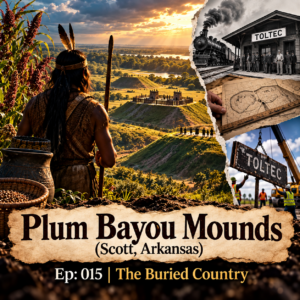 Watch the episodePlum Bayou Mounds (Scott, Arkansas) Ep: 015 | The Buried CountryWatch and read →
Also in Arkansas
Sources
- Arkansas Archeological Survey: Toltec renamed Plum Bayou Mounds
- Encyclopedia of Arkansas: Plum Bayou Mounds Archeological State Park
- Arkansas Tourism: Arkansas’ largest ceremonial mound site
- Arkansas Democrat-Gazette: State renames Toltec Mounds park to Plum Bayou
- Archaeology Magazine: Plum Bayou Mounds
Spot a mistake, or know more about this place? Tell us.




