- Built by
- Mississippian
- When
- c. 1000–1450 CE
- Where
- Moundville, Hale and Tuscaloosa counties
- Visiting
- Open to the public.
One of the two great capitals of the Mississippian world alongside Cahokia: 29 platform mounds arranged around a vast plaza on the bluffs of the Black Warrior River. A museum on site holds objects excavated there.
The story
Eight centuries ago, on a bluff above the Black Warrior River, Moundville was one of the largest towns in North America. Its people built 29 earthen platform mounds in a great ring around an open plaza, and on their flat summits stood temples, council houses and the homes of leading families. Only Cahokia, far to the north in Illinois, rivaled it in the Mississippian world.
The town grew slowly at first. The surrounding valley was already home to many farming families, but few mounds rose here before about 1200 CE. Then, within a few generations, Moundville became the capital of a society that reached across much of present-day Alabama. Every mound was built by hand, from basket after basket of earth carried from nearby pits, which have since filled with water and become the small lakes you see today. The plaza itself was filled and leveled with the same patient labor.
The layout was not random. Scholars believe the largest mounds on the north side belonged to the highest-ranking clans, with smaller mounds paired around the plaza for homes, ceremonies and the care of the dead. Mound A stands at the center of the plaza. Just north of it rises Mound B, about 58 feet tall with a base of about two acres, the tallest mound at the site.
By the 1400s, Moundville was changing. Fewer people lived in the town itself, and it became more a sacred center and burial place for the region than a crowded capital. By the 1500s, when Spanish expeditions crossed the Southeast, the great town was a shadow of what it had been.
What was found here
The artists of Moundville were among the finest in the ancient Southeast. Excavations have uncovered painted pottery, stone pipes, copper ornaments, engraved shell, and palettes, flat stone disks once used to grind and mix pigments. The most famous is the Rattlesnake Disk, a sandstone palette carved with two horned rattlesnakes circling an open hand with an eye in its palm. It is now Alabama’s official state artifact. Another treasure, a bowl carved from stone in the shape of a crested bird, shows the same mastery.
Moundville’s modern history is a story of near loss and rescue. Collectors dug into the mounds in the 1800s, and in 1905 and 1906 Clarence B. Moore removed many of its finest objects. In the 1920s, state geologist Walter B. Jones led a local effort to save the site, even mortgaging his own home to help buy the land. Mound State Park opened in 1933. During the Great Depression, young men of the Civilian Conservation Corps restored the mounds and built roads and a museum, which opened in 1939. Moundville became a National Historic Landmark in 1964 and took its present name, Moundville Archaeological Park, in 1991.
For decades the museum displayed human burials uncovered at the site. That display was closed in 1989, a change that honored the ancestors who rest here. Even now, only a small part of the ancient town, about 14 percent, has ever been excavated.
The people of Moundville today
Moundville’s descendants are still here. The mounds are a sacred place for many Southeastern Native nations, especially Muskogean-speaking peoples. Every October, the park hosts the Moundville Native American Festival, often called the “City of Life,” where Choctaw, Chickasaw, Muscogee (Creek), Seminole, Coushatta and other nations share dance, music, stories, food and craft with thousands of visitors, many of them schoolchildren.
When you walk the plaza, you are walking through someone’s ancestral home. Treat it as you would a cathedral or a cemetery, because it is both.
Visiting
Moundville Archaeological Park is run by the University of Alabama Museums, less than 20 miles south of Tuscaloosa. The park includes the Jones Archaeological Museum, which reopened in 2010 after a major renovation and holds many of the site’s finest objects, along with a nature trail, picnic areas and camping along the river. Stairs lead to the top of Mound B, where you can look out across the plaza and the whole ring of mounds.
- Check hours, admission and festival dates on the park’s official site before you go.
- Climb only where stairs are provided, and stay off all other mounds.
- Leave everything as you found it. Collecting artifacts, even small sherds, is against the law.
- During the festival, follow the etiquette the organizers share, and ask before photographing dancers or ceremonies.
Plan a respectful visit
Open to the public. Stay on paths, climb only where stairs are provided, and leave everything as you found it. Visiting guidelines
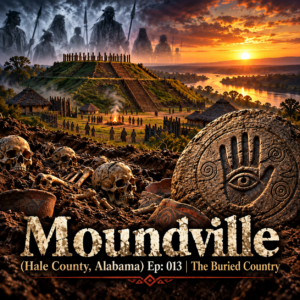 Watch the episodeMoundville (Hale County, Alabama) Ep: 013 | The Buried CountryWatch and read →
Also in Alabama
Sources
Spot a mistake, or know more about this place? Tell us.




